

First edition of PE in 2026. Happy new year and hope you had a restful break!
As we’re entering the 2nd week of 2026, I wanted to share some thoughts and trends I’m seeing in the AI ecosystem. I’ve chatted with many software, AI, and product engineers over the past year through local meetups, workshops, and intros. From these discussions, I’ve noticed two things: engineers are empowered with AI and overwhelmed by AI slop.
This post might sound buzz-wordy, but I promise I’ll keep it straight to the point.
Intro
2025 was a pivotal year for AI. We saw:
Major foundation model advancements from OpenAI (GPT-5 in August), Anthropic (Claude 4 family with Sonnet 4.5 and Opus 4.1), Google (Gemini 3), and Meta (Llama 4 family).
An early acceleration toward reasoning models. It started when DeepSeek R1 disrupted the industry in January by achieving performance comparable to OpenAI’s o1 at a fraction of the training cost (~$6 million vs $100+ million).
The term “vibe coding” gained mainstream traction, popularised by platforms like Lovable and Replit that enable building apps through natural language prompts.
Businesses re-evaluating their strategies with AI and increasingly adopting agentic workflows.
Hiring engineers became more challenging with LLM cheating. The most documented case was the fake candidate interview story with Vidoc Security Lab.
This space is still evolving and I believe 2026 is going to be an inflection point for software engineers.
Trends I’m seeing ahead for 2026:
New wave of AI-native engineers
Increasing demand for standardised agentic orchestration
Vibe coding becoming the de-facto standard for prototyping
AI is booming in the UK
#1 New wave of AI-native engineers
ChatGPT was released on November 30, 2022, and its performance has improved exponentially ever since.
CS undergraduates who started their 4-year programs right as ChatGPT made public are graduating this year. Technically, we’re looking at the first generation of engineers who have been immersed in GenAI throughout their education.
We’re already seeing some engineers being too dependent on AI tools. But on the flip side, they experienced early integration of AI tools and are more equipped for execution than engineers a decade ago. Hiring should expect a new wave of AI-native engineers.
Challenges:
Engineers need to understand, explain, and justify LLM outputs at work and interviews. Blindly accepting outputs is not acceptable.
Critical thinking and debugging will be more emphasised with AI-assisted development.
Opportunities:
Early-career engineers can practice higher-level thinking and feature planning
Engineers will be more productive, contributing to projects faster
Experience with AI becoming a competitive advantage
AI adoption is already happening in SWE interviews…
Some companies now allow candidates to use AI tools like Copilot and Cursor during interviews (with algorithmic interviews being the exception). Meta has been trialling this approach in an attempt to move away from old LeetCode-style interviews. An internal memo reads:
Meta is developing a new type of coding interview in which candidates have access to an AI assistant. This is more representative of the developer environment that our future employees will work in, and also makes LLM-based cheating less effective.
Candidates will still need algorithmic thinking. The idea is to provide an environment for candidates to solve problems using AI tools and to be able to justify their decisions and explain the outputs they’re using to solve.
Task-based interviews are popular among startups and scale-ups, and they’re increasingly more open towards candidates using AI. I’ve covered this before in technical interview guide, which you can read more here:

#2 New demand for Orchestrating agentic AI
TL;DR - I believe we’re close to having a “Kubernetes” version for agentic workflows.
In short, there are two kinds of AI:
Generative (ChatGPT) that generates text based on a user’s prompts.
Agentic (Claude Code) that acts to achieve complex goals with minimal supervision (e.g., coding up a feature, testing, and creating a PR).
Both kinds are increasingly improving. Generative AI has stronger reasoning capabilities, and agentic AI is evolving from a passive assistant to an active collaborator with decision-making capabilities. Orchestration is about employing a network of AI agents, each designed for specific tasks, working together to automate complex workflows.
Engineers are already experimenting with multiple agents executing different tasks concurrently, essentially operating as a tech lead on top of an “AI super team”. But the de-facto orchestration standard hasn’t emerged just yet.
With this trend, I believe there is a need for developer tooling on top of the agentic workflows. For example, monitoring and observability (o11y) will be required to track and manage the progress of agents like Claude Code. Another is managing resources (CPU/Memory) for running agents. All can be unlocked by an orchestration platform that manages these “AI super teams”, the same way Kubernetes manages containers.
Agentic AI is still a hot topic, and businesses are looking for ways to adopt agentic workflows. So I believe there will be a new class of developer tools built primarily for managing AI agents. And upskilling in that area will be a great ROI for engineers.
#3 Vibe coding becoming the de-facto standard for prototyping
While non-technical individuals quickly embraced vibe-coding, engineers preferred an “AI-assisted development” approach. However, prototyping ideas with vibe coding started to be a thing among engineering teams.
Engineers have reported great results in terms of speed and quality when validating new ideas. The ability to create throwaway solutions in temporary repos for technical review makes it easier for engineers to explore new ideas. And with the increasing coding performance of LLMs like Claude and GPT, teams have started prototyping like vibe-coders.
Vellum shared public leaderboards for evaluating LLM performance. The diagram below shows coding performance (last updated 18 Nov 2025).
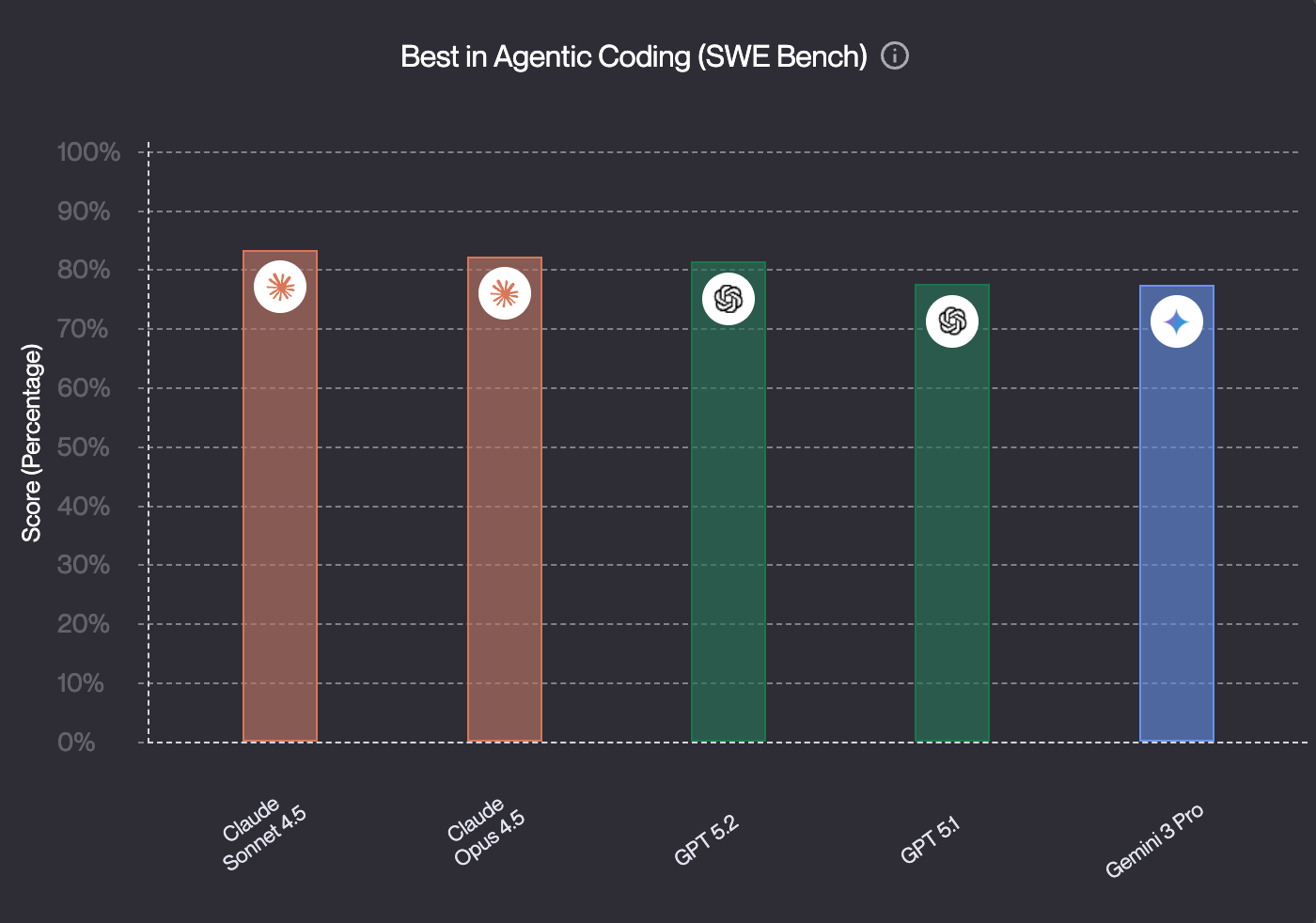
Engineers who are good at prompting and high-level thinking will solve more complex problems faster with accurate code generation. This is a highly valuable skill for AI-native engineers in the job market.
One thing I learned from Addy Osmani, Google Cloud AI Director, who shared recently on the “Pragmatic Engineer” podcast by Gergely Orosz, is that he writes an internal monthly AI newsletter to his engineering org about the latest trends and learnings to empower his engineers to work with AI and establish standardised practices.
He explains that engineers should be curious about AI and contribute to defining standard guidelines when working with AI. These efforts will pay off in the long term for an innovation-first culture.
TL;DR - Engineers who keep up with the latest foundational models and are naturally curious will be ahead.
To recap, what makes engineers successful in this environment:
Strong prompting skills combined with architectural thinking
Staying current with foundational models (Claude, GPT, etc.)
Natural curiosity to experiment with new tools as they emerge
#4 AI is booming in the UK
The UK government data shows the number of AI companies has nearly doubled over the past two years, reaching close to 6,000 firms and generating around £24 billion in revenue in 2024, more than double in 2023. Employment in AI has also increased by 33% in just 12 months, with over 86,000 new roles.
Research shows UK businesses are spending an average of £15.9 million on AI, and that figure is expected to grow by 40% over the next two years. Many organisations have started to shift from using AI as a series of isolated technology projects, and implementing enterprise-wide AI strategies.
Latest example is my previous company, Faculty AI. They recently announced acquisition by Accenture for a $1bn, making the company a “tech unicorn”. This is a clear signal of Accenture’s AI strategy. Acquiring Faculty allows them to deploy enterprise-wide AI solutions within their consultancy.
I’ve been fortunate to meet many engineers and founders working on exciting AI products, as well as experience the strong camaraderie in the tech community and supporting other startups as they grow.
No affiliation, here are a very small list of exciting companies (they’re all hiring)!
tldraw (short video for AI-assisted drawing agents, fairies!)
Granola for back-to-back meetings
Synthesia, an AI video platform for businesses
Encord for managing, curating, and annotating AI data
PolyAI for building AI voice agents
Isomorphic Labs, an AI platform for accelerating drug discovery
Wrap up
Going into the second week of 2026, AI will continue to disrupt industries, and it is more important than ever for engineers to be well-equipped with AI. This shift presents both an opportunity and a challenge. Strong judgment, human creativity, and strategic thinking will become some of the most valuable skills for software engineers.
Time to say goodbye to inverting binary trees.
To recap, these are the trends I’m looking forward to:
New wave of AI-native engineers
Increasing demand for standardised agentic orchestration
Vibe coding becoming the de-facto standard for prototyping
AI is booming in the UK
If you enjoyed this newsletter, consider subscribing and sharing it with a friend.